

09-02-26
Beyond the control room: emerging insights on HFE for SMRs
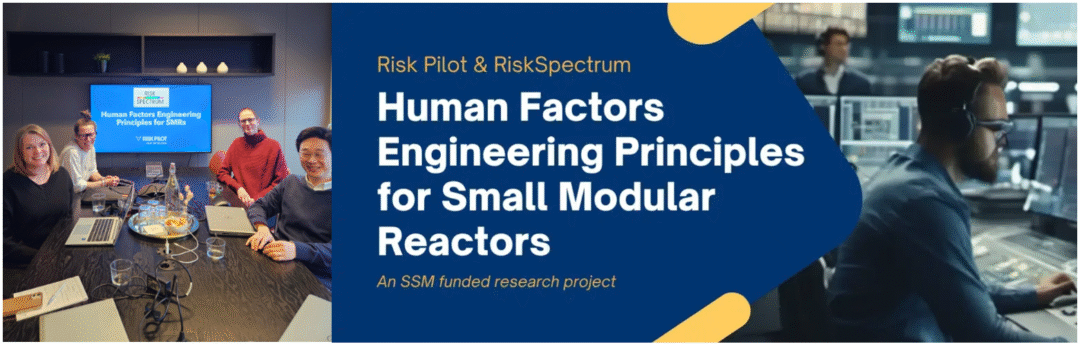
Last week marked the first of two internal workshops for our research project exploring Human Factors Engineering (HFE) Principles for Small Modular Reactors (SMRs). The project is a two-year research collaboration between Risk Pilot AB and RiskSpectrum AB, funded by the Swedish Radiation Safety Authority (Strålsäkerhetsmyndigheten, SSM). The goal of the project is to understand whether, and how, the unique characteristics of SMRs may reshape the role of the human, and whether today’s HFE principles remain fit for purpose or need to be adapted.
We came together in person in Stockholm to review and reflect on the findings from Work Packages 1 and 2, which are now nearing completion. This first phase of the work has focused on the current state of practice for HFE in the nuclear industry, both in Sweden and internationally. The work has examined regulatory frameworks in selected countries investing in SMR technologies, as well as insights from experienced HFE practitioners.
The workshop allowed us to explore our findings to date in more depth and to consider what this might mean for the next phase of the project, and ultimately for future SMR deployment in Sweden.
One emerging insight is particularly interesting: while the principles of HFE themselves are unlikely to change for SMRs, the assumptions underpinning when and how these principles are applied may have to be adapted for SMRs.
Traditionally, HFE in the nuclear industry has focused heavily on the control room, both in terms of design and operational considerations. For SMRs, however, a broader perspective may be needed. Novel reactor designs, combined with new organisational and business models, are likely to reshape not only the human role in the control room, but also how human behaviour and performance manifest outside the control room and across SMR fleets.
Taken together, this suggests that understanding the human contribution to both safety and risk for SMRs may require looking beyond individual workstations to consider wider organisational and system-level interactions.
We’re only about a quarter of the way into this project, and it’s far too soon to draw any firm conclusions. However, it’s already clear that applying “business as usual” HFE approaches, without reflecting on the changing scope of the human role, may not be sufficient for SMRs. In the next phase, we’ll turn our attention to specific SMR designs being considered for deployment in Sweden, to explore where HFE challenges may arise and whether existing regulations, standards, or guidance may need to be adapted.
Linje
Senaste nyheter

SKS Tendens 2026
